
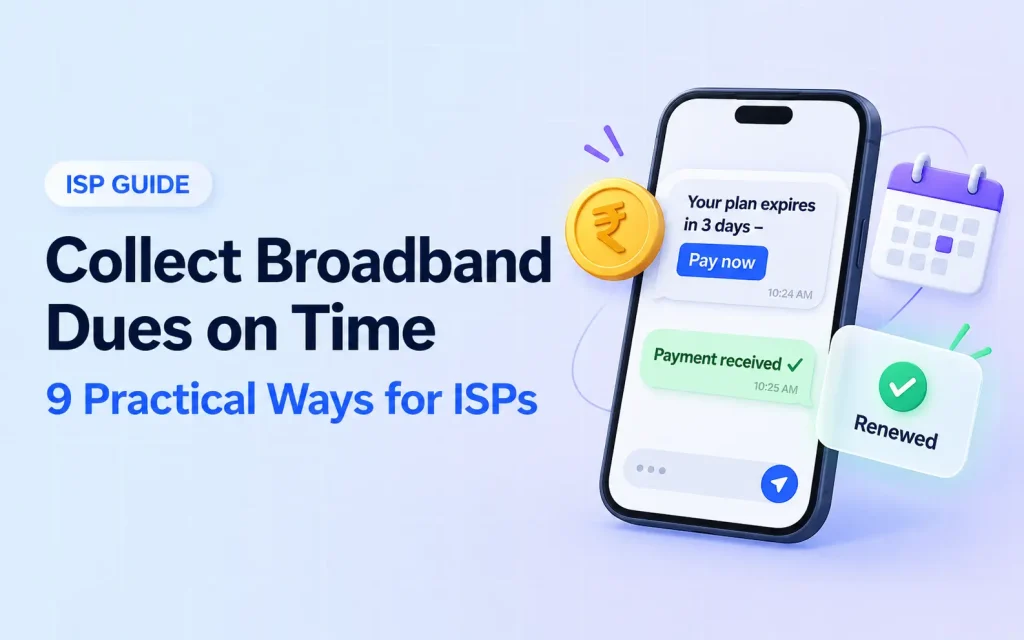
Unpaid dues are the quiet leak in most broadband businesses. Bandwidth bills, salaries and rent go out on time every month, but subscriber payments come in late, in parts, or not at all. This guide covers nine practical ways internet service providers in India can collect dues on time, from how you bill to how you remind, suspend, reconnect and track cash. Most of them work whether you use software or not, and all of them work better when they run automatically.
Why broadband dues pile up
Before fixing collections, it helps to see where the money gets stuck. In most ISPs it is a mix of these:
- No fixed due date. Each subscriber renews on a different day and nobody knows who is due today.
- Reminders go out late. The first call comes after the plan has expired, when the subscriber is already annoyed.
- Paying is harder than not paying. The subscriber has to wait for an agent or visit the office.
- The connection keeps running. If the internet works without payment, there is no reason to hurry.
- Cash goes missing. Field agents collect cash, but it reaches the office days later, or not in full.
- Nobody looks at the total. Dues are spread across registers, Excel sheets and WhatsApp chats.
9 practical ways to collect broadband dues on time
1. Bill in advance, not at the end of the month
Prepaid billing is the simplest way to stop dues from building up. The subscriber pays first and uses the internet after. If you sell postpaid plans to offices or long-standing customers, keep the cycle short and the credit limit small. Read more about the trade-offs in ISP billing in India.
2. Put one clear due date on every bill
Every invoice and reminder should show the plan, the amount and the exact date the connection will stop. “Pay soon” gets ignored; “Your 100 Mbps plan expires on 12 November” gets paid. GST invoices created automatically at each renewal also make the amount look official and final.
3. Remind before expiry, not after
Most subscribers do not refuse to pay. They forget. A short series of reminders before the plan ends brings in most renewals without a single phone call:
| When | What to send |
|---|---|
| 3 days before expiry | Friendly reminder with the amount and a payment link |
| 1 day before expiry | Second reminder: “Your plan ends tomorrow” |
| On the expiry day | Last reminder with the payment link |
| After payment | Confirmation: “Payment received, your plan is renewed until…” |
In India, bulk SMS needs DLT-registered sender IDs and templates, so register your reminder templates once and reuse them. WhatsApp reminders get read faster; with ISPMate they are available through the separate QuickMessage platform.
4. Put a payment link in every reminder
Every extra step loses payments. A reminder with a direct link to pay by UPI, card or net banking turns “I’ll pay later” into a two-minute task. Make sure the payment is recorded against the right subscriber automatically, so your team does not have to match it by hand.
5. Give subscribers a portal and an app
Subscribers who can see their plan, expiry date and dues for themselves pay without waiting for a call. A customer portal and app also lets them check payment history and raise a complaint, which cuts calls to your office.
6. Suspend automatically when the plan expires
This is the step most ISPs avoid, and the one that works best. When an expired account keeps working, the subscriber learns that paying late has no cost. When billing is connected to your network through RADIUS, the connection stops on its own at expiry, for everyone, the same way. If you prefer, give a short grace period first, but keep it the same for all subscribers so nobody feels singled out.
7. Reconnect instantly on payment
Suspension only feels fair if reconnection is fast. When an online payment renews the plan and restores the internet within moments, subscribers stop calling the office to “please start my connection”. It also teaches them that paying online is the fastest way back.
8. Control cash collected by field agents
Cash is still common in many areas, and it is where most leakage happens. Simple rules help:
- Every cash payment is entered at the doorstep, from the agent’s app, with a receipt for the subscriber.
- Cash entries stay “unconfirmed” until the office receives the money and approves them.
- Agents hand over cash daily, and you check each agent’s total against the approved entries.
For franchise partners, use a prepaid wallet: their recharges are deducted from the wallet, so a partner cannot run up dues on your behalf.
9. Look at dues every day, not every month
Dues are easiest to collect in the first few days. A daily view of who is expiring today, who has expired and how much is outstanding, broken down by area or collection agent, lets you act early. Start each morning with the expired list and follow up personally only on the few who did not respond to reminders. If this still lives in Excel, it may be time to move; see 7 signs your ISP has outgrown Excel billing.
Sample reminder messages
Keep reminders short, polite and specific. Adjust the wording to your DLT-approved templates:
- 3 days before: “Hi {name}, your {plan} plan expires on {date}. Renew now to stay connected: {link} – {ISP name}”
- On expiry day: “Hi {name}, your internet plan ends today. Pay {amount} here to avoid interruption: {link} – {ISP name}”
- After payment: “Payment of {amount} received. Your {plan} plan is active until {date}. Thank you! – {ISP name}”
How ISPMate helps ISPs collect on time
ISPMate is cloud-based ISP billing software for internet service providers in India. It puts the steps above on autopilot:
- GST invoices created for every recharge or billing cycle
- Renewal reminders by SMS before expiry, and WhatsApp through ISPMate’s QuickMessage platform
- Online payments by UPI, card or net banking, recorded against the subscriber automatically
- Automatic suspension on expiry and instant reconnection on payment through RADIUS
- Cash collected by field agents tracked as unconfirmed until approved
- Prepaid wallets and commission for resellers and franchise partners
- A customer portal and apps where subscribers check dues and renew on their own
- A dashboard showing today’s collection, pending dues and plans expiring soon
Frequently asked questions
How can an ISP reduce unpaid broadband dues?
Bill in advance, remind subscribers before the plan expires, include a payment link in every reminder, suspend the connection automatically at expiry and reconnect as soon as payment is received. Track dues daily rather than at the end of the month.
When should an ISP send renewal reminders?
A common schedule is three days before expiry, one day before, and on the expiry day, followed by a confirmation once payment is received. Reminders sent after expiry are far less effective.
Is it fair to suspend a subscriber automatically?
Yes, if the rule is clear and the same for everyone. Tell subscribers the expiry date in every reminder, allow a short grace period if you wish, and reconnect immediately when they pay.
How do ISPs stop cash leakage from collection agents?
Record every cash payment at the doorstep with a receipt, keep it unconfirmed until the office receives the money, and reconcile each agent’s daily handover against the recorded entries.
Do I need DLT registration to send SMS reminders in India?
Yes. Commercial SMS in India must use a DLT-registered sender ID and approved templates. Register your reminder and payment templates once and use them for every subscriber.
Want reminders, payments and suspensions to run on their own? Book a free ISPMate demo or call +91-9310313545.