
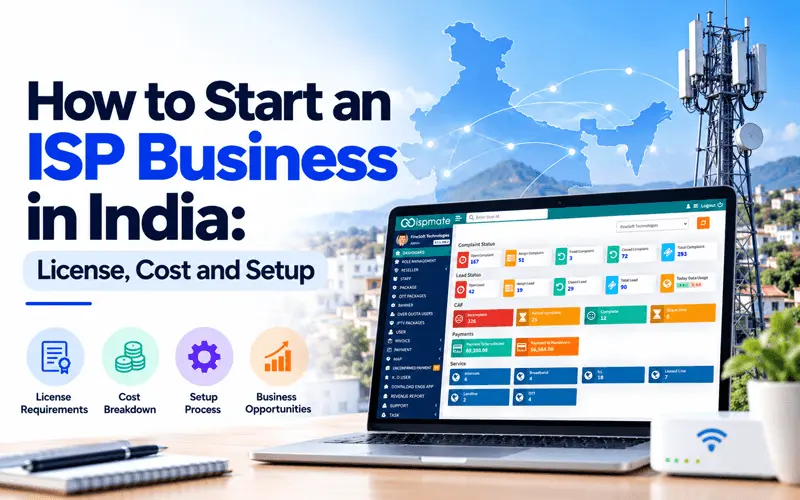
Demand for home and business broadband in India keeps growing, especially in smaller towns where national providers don’t reach every street. That gap is why many cable operators, network engineers and local entrepreneurs start their own internet service. This guide walks through the licence options, what you need to set up, where the money goes, and how to run the business once your first subscribers are live.
Note: Telecom licensing rules in India are being updated under the Telecommunications Act, 2023. Always confirm the current authorisation type, fees and conditions on the Department of Telecommunications (DoT) website or the Saral Sanchar portal before you apply.
Step 1: Choose how you will operate
There are three common ways to enter the market:
Get your own ISP licence or authorisation
You apply to DoT for an internet service authorisation for a chosen service area. Historically, the Unified License offered three ISP categories:
- Category A: all of India
- Category B: one telecom circle or metro
- Category C: one secondary switching area (SSA), roughly a district
Each came with an application fee, an entry fee and bank guarantees, plus an annual licence fee calculated as a percentage of your adjusted gross revenue (AGR). The newer framework under the Telecommunications Act, 2023 may change the categories and amounts, so check the current rules before you budget.
Work as a partner or franchise of a licensed ISP
Many local operators start by partnering with an existing licensed ISP. You build and run the last-mile network and serve customers in your area, while the licence and upstream bandwidth sit with the partner. It is the fastest and cheapest way to start, but you share revenue and depend on the partner’s terms.
Become a Virtual Network Operator (VNO)
A VNO authorisation lets you sell internet services using another operator’s network infrastructure. It suits businesses that want their own brand without building everything from scratch.
Tip: if you are starting small, partnering first and applying for your own licence once you have a few hundred subscribers is a common path.
Step 2: Register the business
Before applying for any licence you will need:
- A registered company (most licences require an Indian company registered under the Companies Act)
- PAN, TAN and GST registration
- A bank account in the company’s name
- An office address for your network operations centre
Step 3: Plan your network
Choose your area
Start with a compact area where you can reach many homes with little cable: housing societies, market areas, or a few dense colonies. A tight first area keeps costs low and installation fast.
Choose the technology
- FTTH (fibre to the home) using GPON/EPON is now the standard for new ISPs: higher speeds, fewer faults, lower maintenance.
- Wireless (point-to-multipoint) works for areas where laying fibre is hard.
- Cable/Ethernet is cheaper at the start but harder to upgrade.
Core equipment
- Upstream bandwidth from a licensed provider or an internet exchange
- Core router / BRAS (MikroTik is common for small and mid-size ISPs)
- OLT for fibre networks, and ONUs/ONTs at customer homes
- Switches, fibre cable, splitters, joint closures and power backup
- RADIUS server for authentication, plan speeds and session control
- Monitoring tools to track uptime and bandwidth
Step 4: Estimate your costs
Costs vary a lot by area, technology and how many homes you plan to connect. Plan for these heads:
| Cost head | What it covers |
|---|---|
| Licence or partnership | application, entry fee, bank guarantees, or partner onboarding |
| Upstream bandwidth | monthly cost per Mbps from your provider |
| Core network | router/BRAS, OLT, switches, servers, power backup |
| Last mile | fibre, splitters, poles or ducts, labour |
| Customer equipment | ONU/router per connection (often recovered through installation fees) |
| Software | billing, RADIUS, complaint management, subscriber app |
| Office and staff | network engineers, field technicians, billing and support |
| Working capital | to cover costs until monthly collections stabilise |
Step 5: Set up billing and operations before launch
New ISPs often get the network running and then try to manage subscribers in Excel. It works for the first few dozen customers and then becomes the biggest headache in the business. Before you connect your first paying customer, set up:
- Billing and renewals: plans, recurring invoices, GST and reminders
- RADIUS integration: so a connection is suspended when a plan expires and restored on payment
- Online payments: so subscribers can pay and recharge without calling you
- Complaint management: every fault logged as a ticket with an engineer assigned
- CAF and KYC records: customer documents stored safely, as required by your licence
- Reports: collections, dues, renewals and complaints at a glance
An ISP billing software like ISPMate brings all of these together, and a customer portal lets subscribers handle recharges and tickets themselves.
Step 6: Compliance you can’t skip
- Customer verification (KYC) and proper record keeping for every connection
- Lawful interception and data retention requirements under your licence or partner agreement
- Licence fee filings based on your revenue, on time
- GST invoicing and returns
Missing these can lead to penalties or suspension, so build them into your process from day one.
Step 7: Get your first subscribers
- Start with one area and do it well: fast installation, quick complaint response
- Offer simple plans (2–4 options) with clear pricing
- Partner with local cable operators, builders and housing societies
- Ask happy customers for referrals; word of mouth is the cheapest marketing for a local ISP
- Track renewals daily; see our guide on the 12 numbers every ISP owner should check daily
Common mistakes new ISPs make
- Spreading the network over too large an area too early
- Under-buying upstream bandwidth, which leads to slow speeds at peak hours
- Managing billing and renewals in spreadsheets
- No system for complaints, so faults go untracked
- Ignoring KYC and compliance until there is a problem
- Running out of working capital before collections become regular
If any of these sound familiar, read the 7 signs your ISP has outgrown Excel billing.
Frequently asked questions
Yes. You need an internet service authorisation from the Department of Telecommunications, or you can operate as a partner or franchise of an existing licensed ISP, or as a virtual network operator.
Partnering with an existing licensed ISP is usually the cheapest way to start, because you don’t pay licence fees or bank guarantees yourself. Many operators apply for their own licence later.
It depends on your subscriber count and plans. Most ISPs buy upstream bandwidth in steps and increase it as subscribers grow, watching peak-hour usage closely.
At minimum: billing with GST, RADIUS for authentication and plan control, online payments, complaint management and customer records. ISPMate provides all of these in one system.
Start with the right systems
The network gets your subscribers online; your systems keep them paying and happy. ISPMate helps new and growing ISPs set up billing, RADIUS, payments and complaints before launch, with setup, data migration and training included. Book a free demo: call +91-9310313545 or write to sales@ispmate.com.