
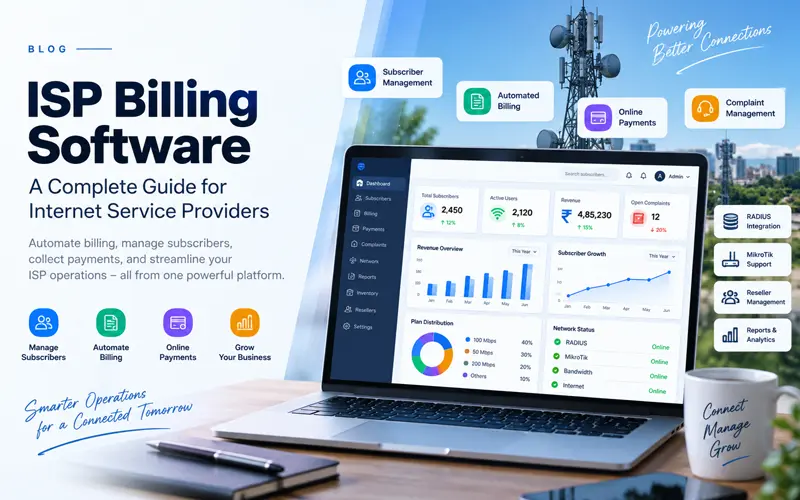
Running an Internet Service Provider (ISP) business involves much more than providing an internet connection. From managing subscribers and plans to generating invoices, collecting payments, handling complaints, controlling bandwidth, and monitoring network activity, ISPs have to manage multiple operations every day.
As the number of subscribers grows, managing these activities manually can become time-consuming and difficult. This is where ISP billing and management software can make a significant difference.
In this guide, we’ll understand what ISP billing software is, how it works, its key features, and why it is an important tool for modern ISPs.
What Is ISP Billing Software?
ISP billing software is a specialized software solution designed to help Internet Service Providers automate and manage their billing, subscriber, payment, and operational processes.
Instead of maintaining separate systems for customers, billing, payments, complaints, and network management, an ISP can use a centralized platform to manage these operations from one place.
A typical ISP management platform can help with:
- Subscriber management
- Internet plan management
- Automated billing
- Invoice generation
- Online payments
- Recharge and renewal
- Customer complaints
- CRM
- RADIUS management
- Bandwidth management
- Reseller management
- Inventory management
- Reports and analytics
- Expense management
- Mobile applications
- Network integrations
Why Do ISPs Need Billing Management Software?
For a small ISP, managing a limited number of customers manually may initially seem manageable. However, as the subscriber base increases, operational complexity also increases.
An ISP may need to track:
- Who has an active connection
- Which plan each customer is using
- When a customer’s plan expires
- Outstanding payments
- Payment history
- Customer complaints
- Installation requests
- Bandwidth usage
- Network sessions
- Reseller customers
- Equipment issued to customers
A centralized ISP billing system can bring these activities together and reduce dependence on spreadsheets and disconnected tools.
Key Features of ISP Billing Software
1. Subscriber Management
Subscriber management is one of the most important components of an ISP management system.
Administrators can maintain customer information such as:
- Name
- Contact details
- Address
- Connection details
- Internet plan
- Billing cycle
- Payment history
- Account status
- Complaint history
- Documents
Having this information in one centralized system makes it easier for support and operations teams to access customer information.
2. Automated Billing
Manual billing can consume significant administrative time.
ISP billing software can automate recurring billing processes and help generate invoices based on the customer’s selected plan and billing cycle.
Depending on the implementation, billing functionality may include:
- Recurring invoices
- Due-date tracking
- Discounts
- Taxes
- Payment status
- Receipts
- Outstanding balance
- Billing history
Automation can help reduce repetitive administrative work.
3. Online Payments
Modern customers expect convenient digital payment options.
An ISP management platform can integrate online payment functionality so customers can pay their bills or renew their plans digitally.
A typical payment workflow can be:
Customer receives payment reminder
↓
Customer opens payment page
↓
Selects payment method
↓
Completes payment
↓
Payment status is updated
↓
Receipt is generated
This creates a smoother payment experience for both the customer and the ISP.
4. Recharge and Plan Renewal
Customers frequently need to renew their internet plans.
A customer portal or mobile application can allow users to:
- View their current plan
- Check expiry date
- Recharge their account
- Renew their plan
- View payment history
- Download invoices
This can reduce the need for customers to contact the ISP for routine renewal requests.
5. Complaint and Ticket Management
Customer support is an important part of ISP operations.
When a customer experiences an issue, the support team needs to track the complaint from registration to resolution.
A ticket management system can provide a workflow such as:
New Ticket → Assigned → In Progress → Resolved → Closed
Each complaint can include information such as:
- Customer details
- Complaint category
- Priority
- Assigned technician
- Status
- Resolution notes
- Ticket history
This provides better visibility into support operations.
6. RADIUS Integration
RADIUS is commonly used in ISP environments for authentication, authorization, and accounting.
Integration between the ISP management platform and RADIUS infrastructure can help automate subscriber access based on account and service information.
This can be particularly useful for managing broadband and PPPoE-based subscribers.
7. MikroTik Integration
Many ISPs use MikroTik devices for network and bandwidth management.
A billing and ISP management platform can integrate with supported network infrastructure to automate activities such as:
- User activation
- User suspension
- Bandwidth profiles
- Authentication
- Session management
- Reconnection
The exact capabilities depend on the network architecture and integration being used.
8. Bandwidth Management
Different customers may subscribe to different internet speed plans.
For example:
- 50 Mbps
- 100 Mbps
- 200 Mbps
- 500 Mbps
A centralized system can connect customer plans with supported bandwidth-management infrastructure, helping administrators manage service profiles more efficiently.
9. Reseller Management
ISPs that operate through resellers or partners may need separate management capabilities.
Reseller management can help administrators track:
- Reseller accounts
- Customers
- Plans
- Pricing
- Payments
- Credits
- Commissions
- Reports
This can make it easier to manage a growing reseller network from a centralized system.
10. Inventory Management
ISPs manage a large amount of networking equipment.
Examples include:
- ONTs
- Routers
- Modems
- Switches
- Cables
- Accessories
- Customer-premises equipment
Inventory management can help track equipment allocation, availability, and customer assignments.
11. Reports and Analytics
Data is critical for running an ISP efficiently.
An ISP management system can provide reports covering areas such as:
- Subscriber growth
- Revenue
- Payment collection
- Outstanding payments
- Plan performance
- Complaints
- Sales
- Expenses
- Bandwidth usage
- Reseller performance
These reports can help management understand business performance and identify operational issues.
ISP Billing Software for FTTH Businesses
FTTH operators have specific operational requirements because they may manage large numbers of fiber connections distributed across different locations.
An ISP management platform can help FTTH businesses manage:
- Fiber subscribers
- Plans
- Billing
- Renewals
- Payments
- Complaints
- Installations
- Customer information
- Network-related operations
As subscriber numbers grow, centralized management becomes increasingly useful.
Benefits of Using ISP Management Software
Reduce Manual Work
Automating repetitive activities such as billing, payment reminders, and reporting can reduce administrative workload.
Improve Customer Experience
Customers can get access to self-service features such as online payments, renewals, invoices, and complaint tracking.
Centralize Operations
Instead of managing information across multiple spreadsheets and systems, teams can work from a centralized platform.
Improve Payment Visibility
Administrators can monitor collected payments, pending payments, and outstanding balances.
Better Support Management
Ticket tracking makes it easier to understand which complaints are pending, assigned, resolved, or closed.
Better Business Visibility
Reports and dashboards provide management with a clearer view of subscribers, revenue, expenses, and operations.
How to Choose the Right ISP Billing Software
Before selecting an ISP billing solution, evaluate the software against your actual business requirements.
Consider the following:
Subscriber Capacity
Make sure the platform can support your current subscriber base and future growth.
Billing Requirements
Check whether the system supports your billing cycles, plans, discounts, taxes, invoices, and payment workflows.
Network Compatibility
Verify support for your network infrastructure, including RADIUS, MikroTik, or other systems you currently use.
Payment Integration
Check whether the available payment methods match the requirements of your customers.
Customer Portal
A customer self-service portal can reduce the workload on support teams.
Reporting
Make sure the system provides the financial, operational, and subscriber reports your business needs.
Reseller Support
If your business uses resellers, verify that reseller management is available.
Mobile Access
Mobile applications can be useful for customers, field engineers, and administrators.
Integration and API
If you already use other systems, check whether the platform provides suitable integrations or APIs.
ISP Billing Software vs. Manual Management
| Manual Management | ISP Billing Software |
|---|---|
| Spreadsheet-based records | Centralized database |
| Manual invoice creation | Automated billing |
| Manual payment tracking | Digital payment tracking |
| Manual renewal reminders | Automated notifications |
| Separate complaint records | Centralized ticket management |
| Limited reporting | Automated reports |
| Difficult to scale | Designed for growth |
| Higher repetitive workload | More process automation |
The right choice depends on the size, architecture, and operational requirements of the ISP.
The Future of ISP Management
The ISP industry is becoming increasingly digital.
Customers expect:
- Faster support
- Digital payments
- Self-service portals
- Real-time information
- Easy plan renewal
- Mobile access
At the same time, ISPs need better visibility into revenue, subscribers, network activity, and customer service.
An integrated ISP management platform can help bring these requirements together in a single operational environment.
Conclusion
ISP billing software is no longer limited to generating invoices. Modern ISP management platforms can bring together billing, subscriber management, payments, CRM, complaints, network integrations, bandwidth management, reseller management, reporting, and other operational functions.
For ISPs looking to reduce manual processes and manage their growing subscriber base more efficiently, a centralized ISP management solution can provide a more structured way to run daily operations.
The key is to choose a platform that matches your network architecture, subscriber requirements, billing model, payment systems, and future growth plans.
Ready to Simplify Your ISP Operations?
Explore how an integrated ISP management platform can help you manage subscribers, billing, payments, complaints, network operations, and business reporting from one place.
Book a Demo and discover the features that fit your ISP business.