
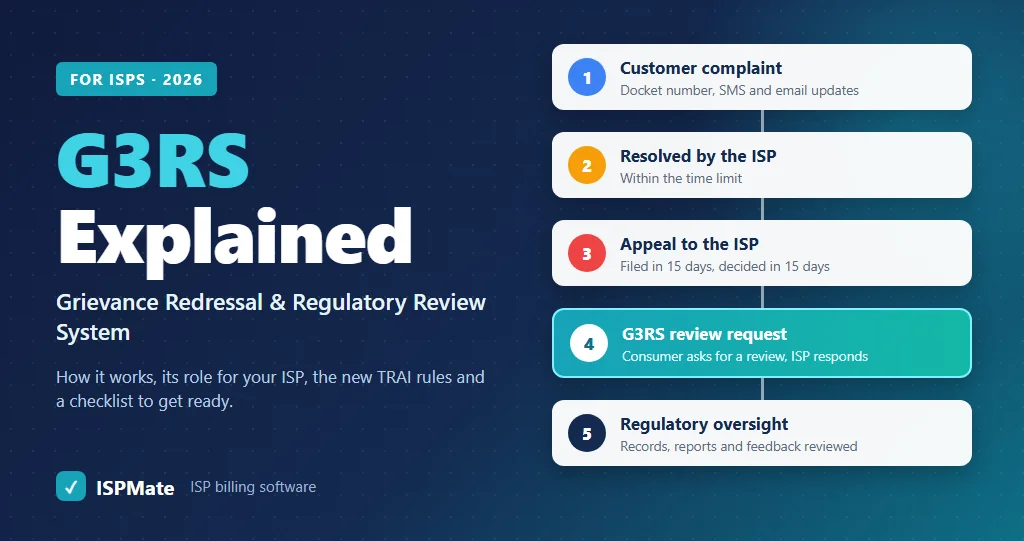
G3RS is a name many ISP owners have started hearing in 2026, but few know what it actually is. G3RS stands for the Grievance Redressal & Regulatory Review System, a TRAI-branded online portal where telecom, broadband, DTH and cable TV consumers can ask for a review of how their complaint was handled. For an ISP, G3RS is the layer above your own complaint desk: if a customer is not satisfied with your complaint centre and appeal process, the complaint can reach the regulator’s review system, with a record of what you did. This guide explains what G3RS is, how it works, its role for ISPs, the TRAI rules behind it, and how to get your ISP ready.
This article is for information only and is not legal advice. Details are based on the G3RS portal and TRAI’s regulations as of November 2026; check TRAI’s website for the latest instructions.
What is G3RS?
The G3RS portal describes itself as a system for “Regulatory Review for Grievance Redressal”, intended “to facilitate transparency, monitoring, and regulatory oversight in the grievance review process”. In simple words, it lets the regulator see how service providers handle consumer complaints, and lets consumers ask for a review when they are unhappy with the result.
Key points from the portal itself:
- Services covered: mobile and fixed-line telecom, home broadband, fibre, wireless broadband and ISP services, DTH, and cable TV.
- For retail customers only: the portal says it “is not intended for Enterprise or Corporate use”.
- ISP first: consumers “are required to first seek redressal of their grievances through the designated complaint redressal framework/mechanism of their respective Service Providers”.
- Does not replace your process: the platform “does not replace or supersede” the grievance redressal mechanism set up under TRAI’s Telecom Consumers Complaint Redressal Regulations, 2012.
- Separate logins: there are separate logins for consumers, service providers and TRAI. Consumers log in with their mobile number and an OTP, lodge a review request and track its status.
Some ISPs already point their customers to G3RS on their websites as their grievance redressal route.
G3RS vs your ISP’s own grievance redressal mechanism
G3RS is often confused with an ISP’s complaint system. They are different:
| Your ISP’s grievance redressal mechanism | G3RS | |
|---|---|---|
| Who runs it | The ISP | TRAI-branded central portal |
| What it is for | Registering and resolving complaints and appeals | Review and regulatory oversight of how complaints were handled |
| When the customer uses it | First, for every complaint | After using the ISP’s complaint and appeal process |
| Parts | Complaint Centre, Complaint Monitoring System and Appellate Authority | Consumer review requests, service provider dashboard and TRAI monitoring |
| Required by | TRAI’s complaint redressal regulations | Built for TRAI’s regulatory review of grievance redressal |
Note that TRAI does not resolve individual complaints itself. The portal states that the TRAI Act, 1997 “does not envisage handling of individual consumer complaints by TRAI”. The responsibility to resolve the complaint stays with the ISP. G3RS makes that work visible.
How G3RS works: a complaint’s journey
- Complaint to the ISP: the customer complains by phone, website, app or another channel and gets a docket number.
- Resolution: the ISP resolves it within the time limit, or within three days where no other limit is set, and sends updates by SMS and email.
- Appeal to the ISP: if not satisfied, the customer appeals to the ISP’s Appellate Authority within 15 days. The ISP decides and acts within 15 days.
- Review request on G3RS: if still not satisfied, the customer can log in to G3RS and lodge a review request against the ISP.
- ISP responds: the request reaches the service provider through its G3RS login, and the ISP responds on the portal.
- TRAI oversight: TRAI can see requests, responses and patterns across providers.
The better your ISP handles steps 1 to 3, the fewer cases reach step 4, and the easier it is to show what you did when one does.
The role of G3RS for ISPs
- Your complaint handling is now visible. Unresolved or badly closed complaints no longer stay inside your office. They can reach the regulator.
- Records become evidence. To respond to a review request, you need the docket number, dates, actions taken, the appeal decision and the messages sent. Without records, you cannot show you followed the rules.
- It links to penalties. Under the 2026 amendment, TRAI can review providers’ grievance redressal through audits, quarterly reports and consumer feedback, and impose financial disincentives for complaints and appeals disposed of against the rules (see below).
- It rewards a good appeal process. A fair, fast Appellate Authority settles most disputes before they reach G3RS.
- It affects your reputation. Customers who feel ignored now have a regulator-branded place to go. Good handling at the first step protects your brand.
The TRAI rules behind G3RS (2026 amendment)
On 2 November 2026, TRAI issued the Telecom Consumers Complaint Redressal (Fourth Amendment) Regulations, 2026. It added a “Regulatory review” provision under which TRAI may periodically review providers’ grievance redressal by auditing records, analysing quarterly reports and reviewing consumer feedback, may set up a mechanism to seek reports from providers, and providers must supply the data TRAI asks for through that mechanism. The main changes for ISPs:
| Area | What the rules say |
|---|---|
| Who it applies to | ISPs with more than 10,000 subscribers on the last day of the previous financial year. Smaller ISPs must still have a suitable complaint redressal mechanism. |
| Complaint centre | Open round the clock; human help at least 16 hours a day; Hindi, English and a state language where applicable; free consumer care number |
| Channels | Complaints and appeals through website and mobile app, with docket number, expected resolution time, delay notices and closure message |
| Time limit | As per TRAI’s quality of service and other regulations; three days where no limit is set |
| Appeals | Filed within 15 days (was 30); unique appeal number; decided and acted on within 15 days; outcome sent within three days |
| Appellate Authority | Regular management employees with at least five years’ experience; details on website home page and app |
| Feedback | Online survey after every closed complaint and appeal, on a five-point scale |
| Reporting | Quarterly Performance Report to TRAI and on your website and app within 15 days of each quarter; quarterly report to the CEO or Board |
| Records | Kept at least six months after disposal |
| Oversight | Consumer Grievance Redressal Oversight Committee with TRAI-registered consumer organisations, meeting at least once a year |
The provisions come into force in phases, 30, 60 and 90 days after publication in the Official Gazette.
Penalties
| Contravention | Financial disincentive |
|---|---|
| Complaint disposed of against the regulations | ₹1,000 per complaint |
| Appeal disposed of against the regulations | ₹5,000 per appeal |
| Cap for the above | ₹20 lakh per quarter per service area |
| Quarterly Performance Report late | Up to ₹5,000 per report per day for the first 15 days, then ₹20,000 per day, up to ₹10 lakh per instance per service area |
How to get your ISP ready for G3RS
| Task | Done? |
|---|---|
| Check your subscriber count on 31 March of the last financial year | ☐ |
| Give every complaint a docket number, on every channel | ☐ |
| Set a time limit for each complaint type and track tickets that cross it | ☐ |
| Send status updates by SMS and email until the complaint is closed | ☐ |
| Appoint an Appellate Authority and publish their details on your website and app | ☐ |
| Register appeals with a unique number and decide them within 15 days | ☐ |
| Close complaints only after real resolution, and send a feedback survey | ☐ |
| Keep complete records of complaints, appeals and actions for at least six months | ☐ |
| Name a person to watch G3RS review requests and respond on time | ☐ |
| Review repeat complaints every month and fix the cause | ☐ |
Small ISPs with 10,000 subscribers or fewer
Smaller ISPs are outside the full 2026 rules, but they must still have a suitable complaint redressal mechanism. The habits above cost little and protect you: a docket number for every complaint, time limits, status updates and records. If you cross 10,000 subscribers, you get only 30 days from the end of that month to comply with most of the rules.
How ISPMate helps with G3RS
ISPMate is cloud-based ISP billing software for internet service providers in India. Its ticketing, complaints and G3RS module keeps the record of every complaint in the same system as your subscribers, plans and payments:
- G3RS grievances and appeals tracked to closure
- Tickets with your own complaint categories, assigned to technicians
- Support dashboard with open, closed and all tickets
- Escalation rules, approval queue and ticket response templates
- Customers raise and follow complaints through the customer app and portal
- Updates by SMS, and by WhatsApp through ISPMate’s QuickMessage platform
Read more in our guide to ISP complaint management software.
Frequently asked questions
What is the full form of G3RS?
G3RS stands for Grievance Redressal & Regulatory Review System. It is a TRAI-branded online portal for reviewing how telecom, broadband, DTH and cable TV service providers handle consumer grievances.
What is the role of G3RS for an ISP?
G3RS lets a broadband customer who is not satisfied with the ISP’s complaint and appeal process ask for a review, and lets TRAI monitor how providers handle grievances. The ISP responds to review requests through its service provider login, so it needs complete records of every complaint and appeal.
Can a customer complain directly on G3RS?
The portal says consumers must first seek redressal through their service provider’s complaint redressal mechanism. G3RS does not replace the ISP’s complaint centre and Appellate Authority, and it is meant for retail customers, not enterprise or corporate users.
Is G3RS the same as an ISP’s grievance redressal mechanism?
No. TRAI’s regulations require each ISP to run its own grievance redressal mechanism, made up of a Complaint Centre, a Complaint Monitoring System and an Appellate Authority. G3RS sits above it as a review and oversight system.
Do TRAI’s complaint redressal rules apply to small ISPs?
The full regulations apply to ISPs with more than 10,000 subscribers on the last day of the previous financial year. ISPs with 10,000 or fewer subscribers must still set up a suitable mechanism to redress consumer complaints, and may follow the regulations voluntarily.
Want every complaint and appeal on record, ready for G3RS? Book a free ISPMate demo or call +91-9310313545.
Sources: G3RS portal (Grievance Redressal & Regulatory Review System); Telecom Consumers Complaint Redressal (Fourth Amendment) Regulations, 2026 (07 of 2026), TRAI notification dated 2 November 2026, available on the TRAI website. For information only, not legal advice. Last reviewed: November 2026.