
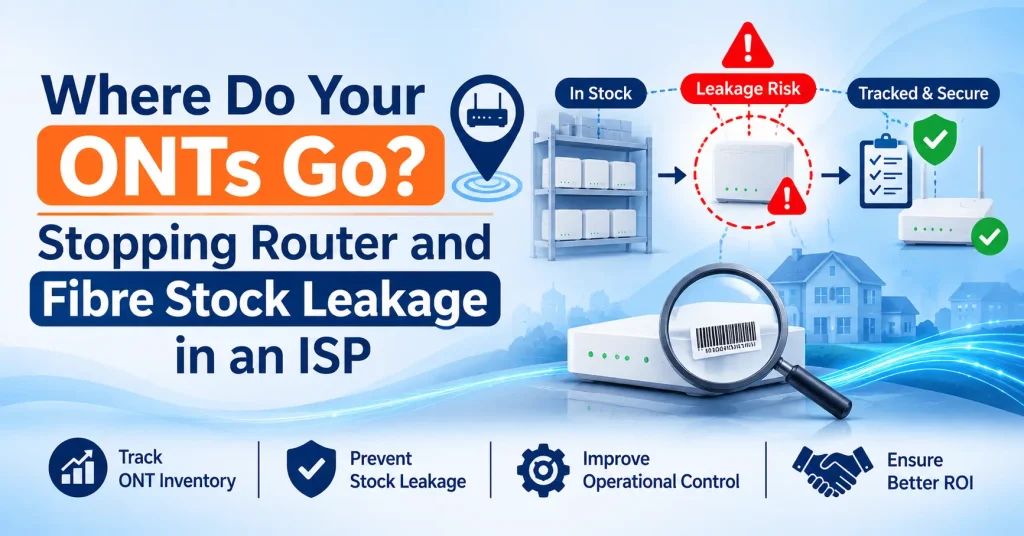
Every ISP buys ONTs, routers and fibre in bulk. A few months later the numbers do not match. The purchase register says 500 ONTs, the store has 90, the billing system shows 360 active connections, and nobody can say where the other 50 went. Fibre is worse: drums are issued, but no one knows how many metres went into each connection. This quiet loss is called stock leakage, and for a small ISP it can eat a large part of the monthly profit. This guide explains where ONTs, routers and fibre usually go missing, how much it costs, and a simple system to stop it.
Where ISP stock usually goes missing
| Leak | What happens | Why it is missed |
|---|---|---|
| Engineer bags | Engineers carry spare ONTs and routers, and some are used, swapped or lost without an entry | Stock is issued in bulk, not against a named job |
| Replacements | A faulty device is replaced at a customer’s home, but the faulty one never comes back to the store | No one tracks the return of the old device |
| Disconnected customers | A customer leaves and keeps the ONT or router | Device recovery is not part of the disconnection process |
| Failed or cancelled installations | The device is taken out for a new connection that never goes live | The job is closed, but the device is not returned |
| Fibre over-use | Far more drop cable is used, wasted or diverted than each connection needs | Fibre is issued by drum, not by metres per job |
| Partner and franchise stock | Devices given to resellers or franchise partners are not matched with their connections | Partner stock sits outside the main store records |
| Warranty and repair | Faulty devices sent to the vendor for repair or replacement are never followed up | No list of devices waiting with the vendor |
| Wrong entries | Devices are received, moved or installed but the register is not updated | Stock is kept in Excel or a notebook |
Most of this is not theft. It is missing process: stock moves, but the record does not move with it.
How much does stock leakage cost?
Here is a simple example for an ISP adding about 60 connections a month. Use your own numbers.
- Average cost of an ONT or router: ₹1,800
- Devices that go missing each month (engineer stock, unreturned replacements, devices not recovered from disconnected customers): 10
- Average fibre drop per connection actually needed: 150 metres, but 200 metres issued on average
- Cost of drop fibre: about ₹6 per metre
Devices: 10 × ₹1,800 = ₹18,000 a month. Fibre: 60 connections × 50 extra metres × ₹6 = ₹18,000 a month. Together that is about ₹4.3 lakh a year, before counting connectors, splitters, patch cords and the time spent searching for missing stock.
A simple system to stop the leakage
1. Record every device by serial number
When a box arrives from the vendor, enter each ONT and router individually with its serial number or MAC address, model, purchase price, vendor and date. Count-only records (“50 ONTs received”) make it impossible to trace a single device later.
2. Use stores, not one big pile
Create a separate store for each office, zone or franchise. Every movement between stores is a transfer with a sender, receiver and date. You then know exactly how much stock each location holds.
3. Issue stock to a named engineer
Engineers should hold stock in their own name, like a mini store. Each device issued, used or returned is recorded against them. At any time you can see what each engineer is carrying.
4. Link every installed device to a customer
When a connection goes live, the ONT or router is moved from the engineer’s stock to the customer’s account. Now the subscriber profile shows which device is at their home, and the engineer’s stock goes down by one.
5. Make returns compulsory
- Replacement: a new device is issued only when the old one is recorded as returned, or the ticket stays open until it is.
- Cancelled installation: the device goes back to the engineer’s stock or the store before the job is closed.
- Faulty devices: keep them in a separate “faulty” or “sent for repair” status with the vendor’s name, so warranty claims are followed up.
6. Recover devices at disconnection
Add device recovery to every disconnection. Decide your policy in advance: free device with recovery on exit, a refundable security deposit, or the device sold to the customer. Write it in the customer application form and on the invoice, so there is no argument later. For customers who leave, see also our guide on how to retain broadband customers.
7. Track fibre in metres, not drums
Record each drum when it is bought, with its length. When fibre is issued to an engineer, record the metres. When a connection goes live, record the metres used for that customer. The difference between what was issued and what was used should come back or be explained. A note of the cable marking at the start and end of each job makes this easy.
8. Verify stock every month
Once a month, count the store, each engineer’s stock and fibre in hand, and compare with the system. Investigate every difference while it is still fresh. Engineers quickly learn that stock is checked, and leakage drops.
Numbers to watch every month
- Devices installed vs new connections: these should match. More devices than connections means stock is going somewhere else.
- Stock with each engineer: watch for engineers whose stock keeps growing or whose numbers do not add up.
- Replacements per month: a high number may point to a bad batch, poor installation or devices being swapped without need.
- Devices recovered vs disconnections: the share of disconnected customers whose device came back.
- Average fibre metres per connection: by engineer and by area.
- Devices waiting with vendors: how many, and for how long.
Common mistakes
- Counting boxes, not devices. Without serial numbers, one missing device cannot be traced.
- Keeping stock in Excel. Spreadsheets are updated late, by one person, and are easy to edit without a trace.
- Separating stock from billing. When the inventory is not linked to subscribers and tickets, devices installed at a customer’s home are not matched to an active connection.
- No owner for returns. If nobody is responsible for collecting faulty and disconnected devices, they stay in the field.
- Checking only once a year. By then the trail is cold, and many staff have changed.
How ISPMate helps you track every ONT and metre of fibre
ISPMate is cloud-based ISP billing software for internet service providers in India. Its inventory and fibre wire tracking works in the same dashboard as billing, subscribers and complaints:
- Stock in, purchase history, multiple stores and store transfers
- Devices assigned to engineers and customers
- Fibre wire tracked from purchase to engineer to customer
- Stock and wire verification and transfers
- Vendor and product management
- Tasks assigned to engineers and tracked until closed, with staff and field team management
- Deep audit logs of every change made by staff and partners
Planning or expanding a fibre network? Read our guides on GPON vs EPON, how many subscribers to put on one PON port and reducing downtime from fibre cuts.
Frequently asked questions
What is stock leakage in an ISP?
Stock leakage is the loss of ONTs, routers, fibre and other materials without a record of where they went. It usually happens through engineer stock, unreturned replacements, devices not recovered from disconnected customers and fibre used beyond what each connection needs.
How should an ISP track ONTs and routers?
Record every device by serial number or MAC address when it is received, keep separate stores for each location, issue devices to named engineers, and move each device to the customer’s account when the connection goes live. Returns of faulty and recovered devices should also be recorded.
How can an ISP track fibre cable usage?
Record the length of each drum on purchase, the metres issued to each engineer, and the metres used for each connection. Compare issued and used fibre every month, and check the average metres per connection by engineer and area.
Should ISPs take back the ONT when a customer disconnects?
If the device was given free or against a deposit, yes. Make device recovery part of every disconnection, and state the policy in the customer application form and invoice, so the customer knows in advance whether the device must be returned.
How often should ISP stock be verified?
At least once a month. Count the store, each engineer’s stock and the fibre in hand, compare it with the system and investigate every difference while it is still easy to trace.
Not sure where your ONTs are going? Book a free ISPMate demo or call +91-9310313545.
Device and fibre prices and leakage figures are an illustrative example; use your own purchase prices and records. Last reviewed: November 2026.