
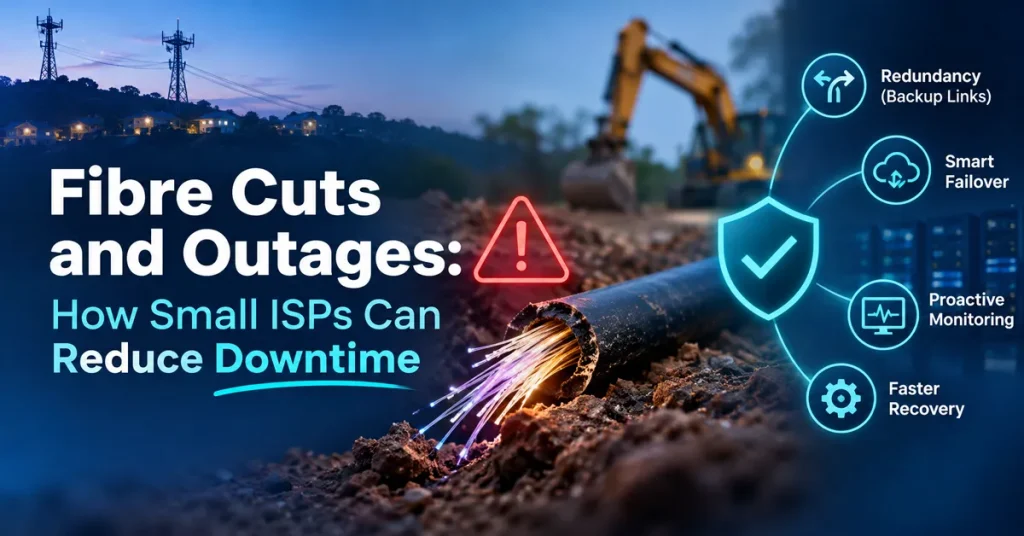
For a small ISP, one fibre cut can take hundreds of homes offline at once. The phones start ringing, complaints pile up, and some subscribers start asking neighbours which other provider they use. You cannot stop every road-digging crew or every rat, but you can make cuts less likely, find them faster, fix them sooner and keep customers informed while you work. This guide explains how small ISPs in India can reduce downtime from fibre cuts and other outages, step by step.
Why outages hurt a small ISP more
A large operator has backup routes, a network operations centre and teams in every area. A small ISP often has one route from the upstream provider, one main OLT and a few technicians. That means:
- One cut on the main route can take down the entire network
- Every hour offline brings a flood of calls to a small support team
- Repeated outages are one of the main reasons subscribers leave at renewal time
The good news is that most of the fixes below cost far less than the customers you lose to a single bad week. For more on keeping subscribers, see how to retain broadband customers.
Common causes of fibre cuts and outages
| Cause | Typical example |
|---|---|
| Road and drain digging | JCB or trenching work by a contractor, municipality or another utility |
| Pole and wire work | Electricity poles shifted, or cables pulled down during line repairs |
| Rodents | Rats chewing cables in ducts, ceilings and building shafts |
| Weather | Storms, falling branches and water entering joint closures |
| Theft and damage | Cables cut by mistake or on purpose, often mistaken for copper |
| Power failure | OLT, switch or POP goes down when batteries run out |
| Equipment and upstream faults | Failed SFP, power supply or switch, or a problem at your bandwidth provider |
Keep a simple record of every outage with its cause. After a few months you will know whether your biggest problem is digging, power, rodents or one weak route, and where to spend first.
Part 1: Make cuts less likely
1. Keep an accurate route map
Many small ISPs know their routes only in the heads of one or two senior technicians. Record every route, joint closure, splitter and OLT port on a map, even a simple one using Google My Maps or a spreadsheet with GPS points. When a cut happens, a map saves hours of searching, and it helps you warn digging crews before they start.
2. Register underground routes and talk to digging agencies
The Department of Telecommunications runs the Call Before u Dig (CBuD) app, which lets excavation agencies alert owners of underground assets before they dig. Register your underground routes where you can, and build contacts with your local municipal office, electricity department and road contractors. A phone call before digging starts is much cheaper than a night of splicing.
3. Use the right cable in the right place
- Use armoured or rodent-resistant cable in ducts, basements and areas with a known rat problem
- Use proper clamps and hardware on poles, and keep enough slack at each pole for repairs
- Seal joint closures well, so water does not enter during the monsoon
- Label cables at poles, buildings and joints with your company name and a contact number
4. Protect your power
Many “outages” are power cuts at the OLT or POP, not fibre problems at all. Size your UPS or battery backup for the longest power cut you normally see in that area, check battery health regularly, and keep a generator or inverter plan for long cuts. Get an alert when equipment switches to battery, so you know before it runs out.
Part 2: Build backup into the network
5. Get a second upstream link
If all your bandwidth comes through one fibre from one provider, any cut on that route takes everyone offline. A second link, ideally from a different provider over a different physical path, lets traffic move over automatically when one fails. Even a smaller backup link that carries essential traffic is far better than nothing. Ask both providers for their exact route, because two links in the same trench will fail together.
6. Use ring routes for your main fibre
In a simple “tree” network, a cut on the main feeder takes down everything after it. In a ring, the main fibre runs in a loop, so if one side is cut, traffic can reach the area from the other side. Start with rings for your busiest routes, such as between your POP and the main OLT locations, and extend over time.
7. Plan OLT and PON ports with room to spare
Do not fill every PON port to its limit. Spare ports and spare fibres let you move subscribers to a working port quickly when one fails. If you are choosing or upgrading PON technology, our comparison of GPON vs EPON explains the differences.
Part 3: Find faults faster
8. Monitor the network, do not wait for calls
If you only learn about an outage when subscribers call, you have already lost time. Use monitoring tools that check your upstream links, OLTs, switches and important ONTs every minute or two, and send alerts to the technician on duty by SMS or app notification. Bandwidth monitoring tools also show when traffic suddenly drops in one area, which is often the first sign of a cut.
9. Use an OTDR to locate cuts
An OTDR (optical time-domain reflectometer) sends light down the fibre and shows the distance to a break or a bad joint. With an accurate route map, an OTDR reading can tell your team which stretch of road to check, instead of walking the whole route. Many small ISPs share or rent an OTDR at first, but owning one pays off once you have several routes.
10. Group complaints by area
When 40 subscribers in the same colony call within ten minutes, it is one outage, not 40 problems. A complaint management system that shows tickets by area helps you spot an area-wide fault quickly, send one team to the right place, and close all related tickets once it is fixed.
Part 4: Fix faults sooner
11. Keep a ready restoration kit
Restoration time often depends on whether the team has the right items at hand. Keep a ready kit in each area or vehicle:
- Fusion splicer, cleaver and stripping tools
- Spare fibre cable of different core counts, and spare joint closures
- Splice protection sleeves, cleaning supplies and a power meter
- Spare SFPs, ONTs, splitters and patch cords
- Lights, a generator or power bank for night work, and safety gear
12. Have an on-call plan
Many cuts happen in the evening or at night. Decide who is on call each night, who they call next if they cannot reach the site, and who can approve buying materials at midnight. Write down a target restoration time, such as within four hours for a main route cut in town, and measure how often you meet it.
13. Do a short review after every major outage
After each big outage, spend 15 minutes on four questions: what happened, how long it took to find, how long it took to fix, and what would prevent it next time. These small reviews are how a network gets stronger month by month.
Part 5: Keep subscribers informed
Customers are far more patient when they know what is happening. During an outage:
- Tell affected subscribers quickly by SMS or WhatsApp that you know about the problem and are working on it
- Give an expected restoration time, and update it if it changes
- Send a message when service is back, and ask them to restart the router if needed
- Consider extra days of validity after a long outage, as a goodwill gesture
WhatsApp messages must go through the official WhatsApp Business API with approved templates, to subscribers who have agreed to receive them. ISPMate’s sister platform QuickMessage provides WhatsApp messaging for ISPs.
How to measure downtime
Track these numbers every month:
- Number of outages, split by cause
- Average time to restore service, from first alert to fix
- Uptime percentage for your main network
Example: A 30-day month has 720 hours. If your network was down for a total of 3.6 hours, uptime was (720 − 3.6) ÷ 720 × 100 = 99.5%. Aim to raise uptime and cut restoration time a little every quarter.
Where to start on a small budget
| Priority | Step | Why |
|---|---|---|
| 1 | Route map and outage log | Costs almost nothing and speeds up every repair |
| 2 | Battery backup and alerts at OLT/POP | Prevents many outages that are really power cuts |
| 3 | Network monitoring with alerts | You find out before customers call |
| 4 | Restoration kit and on-call plan | Cuts repair time |
| 5 | Second upstream link on a different path | Removes the biggest single point of failure |
| 6 | Rings on main routes | Keeps areas online during a cut |
How ISPMate helps during outages
ISPMate is cloud-based ISP billing software for internet service providers in India. It does not monitor fibre, but it helps your team handle the customer side of an outage:
- Complaint tickets with technician assignment and status tracking
- Subscriber records by area, so you know who is affected
- SMS messages, and WhatsApp through QuickMessage, to keep subscribers informed
- Reports on complaints and resolution times, so you can see which areas need attention
- A cloud system your office can use even when your own local network is down
Planning a new fibre route? See our guide to fibre cable connections.
Frequently asked questions
What is the most common cause of fibre cuts in India?
Road and drain digging by contractors and other utilities is one of the most common causes, along with pole work, rodents, storms and theft. Keeping an outage log helps you find the main cause in your own area.
How can a small ISP reduce downtime from fibre cuts?
Keep an accurate route map, add battery backup and alerts at the OLT, monitor the network, keep a restoration kit ready, take a second upstream link on a different path, and build rings on main routes over time.
What is an OTDR and does a small ISP need one?
An OTDR is a test instrument that shows the distance to a break or bad joint in a fibre. It helps teams find cuts quickly. Small ISPs can rent or share one at first, but owning one pays off once the network has several routes.
How should an ISP inform customers during an outage?
Send a quick message to affected subscribers saying the problem is known, give an expected restoration time, update it if it changes, and send another message when service is back. WhatsApp messages should use the official Business API and approved templates.
What is a good uptime target for a small ISP?
There is no single standard, but many ISPs aim for 99.5% or better on their main network, which allows about 3.6 hours of downtime in a 30-day month. Measure your current uptime first and improve it step by step.
Want fewer outage complaints and happier subscribers? Book a free ISPMate demo or call +91-9310313545.