
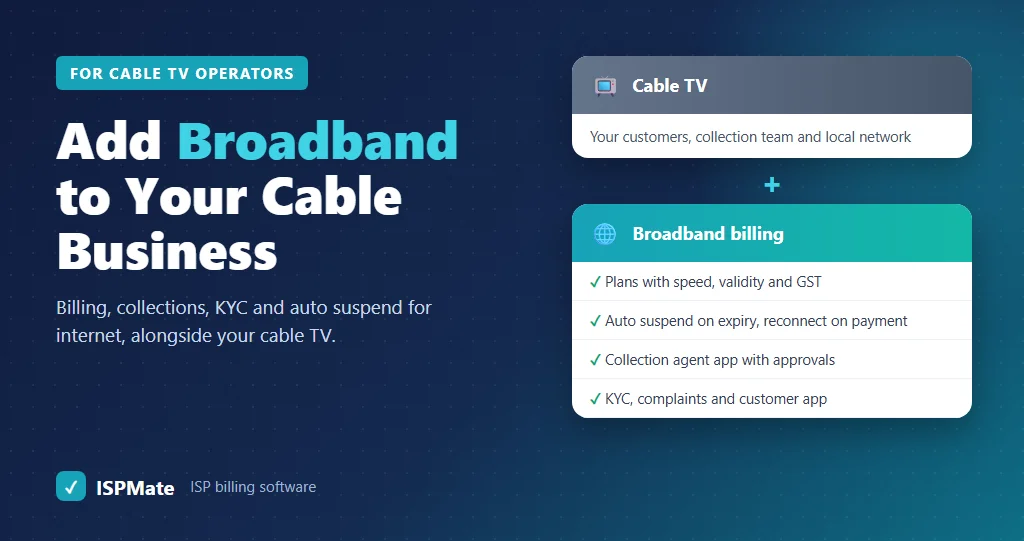
Cable TV operators are in a strong position to sell broadband. You already have customers who know you, a collection team that visits every home, cables and poles in your area, and a local office people trust. What is new is the billing. Broadband is not a fixed monthly cable bill: it has plans with speeds and validity, automatic suspension when the plan expires, KYC, complaints that need a technician, and logs you must keep. This guide explains what changes when a cable TV operator adds broadband, and what billing software you need to run both without confusion.
Why cable operators are adding broadband
- Viewing is moving to the internet. Many households now watch OTT apps and online video, and need a good internet connection for it.
- Same customers, one more service. Selling broadband to homes that already pay you for cable costs far less than finding new customers.
- Your network is already there. Routes, poles and local staff can be used for fibre.
- Higher value per home. A household paying for both TV and internet is worth more, and is less likely to leave.
How a cable operator can start selling broadband
Most cable operators start in one of two ways:
| Option | How it works | Good for |
|---|---|---|
| Partner or franchise of a licensed ISP | You build and run the last mile and serve customers; the ISP holds the licence and provides bandwidth | Starting quickly with less paperwork |
| Your own ISP licence or authorisation | You hold the licence, buy bandwidth and run the whole network | Operators planning to grow larger, with more control and margin |
Read how to start an ISP business in India and our guide to ISP licence categories A, B and C. If you work as a partner, see how ISPs manage franchise and LCO partners, so you know what to expect from your ISP.
Cable TV billing vs broadband billing: what changes
| Cable TV | Broadband | |
|---|---|---|
| Activation | Channels activated through the MSO’s subscriber management system and set-top box | Internet activated through RADIUS on your network, with a username or device |
| What the customer buys | Channel packs | Plans with speed, validity and sometimes a data limit |
| Billing cycle | Usually monthly | Monthly, quarterly, half-yearly or yearly, prepaid or postpaid |
| When the customer does not pay | Channels deactivated through the MSO | Internet suspended automatically on expiry, restored on payment |
| Customer documents | As required for cable connections | KYC and customer application form for every connection |
| Complaints | Signal and set-top box issues | No internet, slow speed, router and fibre issues, often needing a technician |
| Records you must keep | As required by your MSO and regulations | Usage, session and NAT logs, as required by your licence |
| Upselling | Channel packs | Speed upgrades, longer plans, OTT and IPTV packs |
The biggest change: with broadband, billing and the network must work together. When a plan expires, the internet should stop; when the customer pays, it should come back on immediately, without anyone logging into the router. See how this works in our guide to auto suspend and reconnect.
What billing software a cable operator needs for broadband
- Plans with speed and validity: monthly and long-term plans, with GST invoices.
- RADIUS integration: new users created with the right speed, suspended on expiry and reconnected on payment.
- Collection agent app: your collection boys record cash and UPI payments in the field, and every payment is approved before it counts.
- Online payments: customers pay by UPI, card or net banking, and the payment is recorded automatically.
- Area-wise records: customers, dues and collections by area, lane or building, the way you already run cable.
- KYC and CAF: documents collected and checked for every new connection.
- Complaints: tickets assigned to technicians by area and tracked until closed.
- Customer app: customers see their plan, expiry and dues, renew online and raise complaints.
- Inventory: ONTs, routers and fibre tracked from store to engineer to customer.
- Logs: usage, session and NAT logs stored and searchable.
Handling collections the cable way, with fewer leaks
Door-to-door collection is a strength of cable operators, but it is also where money goes missing. With broadband, tighten it:
- Every payment is entered in the app at the customer’s door, with a receipt by SMS.
- Cash stays “pending” until the agent hands it over and the office approves it.
- Each agent has a daily collection report, matched against cash deposited.
- Customers are pushed towards UPI, which is recorded automatically and needs no handover.
More ideas in our guides on how ISPs collect broadband dues and UPI and WhatsApp collections.
Selling broadband to your cable customers
- Start with your existing base. Offer broadband first to cable customers who pay on time.
- Offer a TV + internet combo, with a small discount when both are taken, or free installation.
- Use your collection visits. Agents can tell customers about broadband and note interested homes as leads.
- Add OTT, so customers who watch online get entertainment with their plan. See bundling OTT and IPTV with broadband.
- Promise fast installation in areas where your fibre is ready.
A simple launch plan
| Step | What to do |
|---|---|
| 1. Choose your model | Partner with a licensed ISP, or get your own licence |
| 2. Plan the network | Fibre (usually GPON or EPON) in the areas with the most cable customers |
| 3. Set up billing before the first connection | Plans, GST, payment gateway, RADIUS and collection app |
| 4. Train your team | Collection agents on the app, technicians on installation and complaints |
| 5. Pilot one area | Connect 50 to 100 homes, fix problems, then expand |
| 6. Grow area by area | Use cable customer lists as your sales list |
Choosing fibre technology? Read GPON vs EPON.
Common mistakes
- Running broadband billing in a notebook or Excel, like the cable register. Without RADIUS-linked billing, unpaid customers stay online.
- Skipping KYC because “we know the customer”. Every broadband connection needs proper documents.
- Letting agents collect without entries. Cash that is not recorded at the door is easy to lose.
- Treating internet complaints like signal complaints. Broadband needs tickets, technicians and follow-up.
- Not tracking routers and ONTs, which disappear quickly without records.
How ISPMate helps cable operators add broadband
ISPMate is cloud-based ISP billing software for internet service providers in India, used by local broadband operators and by cable TV operators who also sell internet:
- Plans, renewals and GST invoices, with built-in RADIUS for auto suspend and reconnect
- Online payments by UPI, card and net banking, recorded automatically
- Cash and cheque collected by field agents tracked until approved
- Subscriber KYC and CAF management
- Complaints assigned to technicians, with a mobile app for staff
- Customer portal and app for renewals, dues and complaints
- Inventory and fibre wire tracking
- OTT and IPTV packages sold with internet plans
- Reseller and franchise panels, if you work with partners
Your cable TV channels continue to be managed through your MSO’s systems; ISPMate runs your broadband business alongside them.
Frequently asked questions
Can a cable TV operator start a broadband business?
Yes. Many cable operators start as a partner or franchise of a licensed ISP, using their local network and customer base, while others get their own ISP licence or authorisation. Check the licensing route that fits your plans before you start.
Is broadband billing different from cable TV billing?
Yes. Broadband has plans with speed and validity, needs KYC for every connection, and must be linked to the network through RADIUS so that internet stops on expiry and restarts on payment. Cable channels are activated through the MSO’s systems.
Can cable operators use their collection agents for broadband?
Yes. Collection agents can record cash and UPI payments in a mobile app at the customer’s door. Cash should stay pending until it is handed over and approved by the office, so every payment can be matched.
Can I offer a combined cable TV and broadband package?
Yes. Many operators offer a combo with a discount or free installation when a household takes both services. Show each service clearly on the invoice with the correct GST.
Do cable operators need KYC for broadband customers?
Yes. Every broadband connection needs proper customer verification and a customer application form, even for homes that are already cable customers. Read our guide on digital KYC and CAF for ISPs.
Adding broadband to your cable business? Book a free ISPMate demo or call +91-9310313545.
This article is general guidance, not legal advice. Check licensing, KYC and record-keeping requirements for your area and service before launch. Last reviewed: November 2026.