
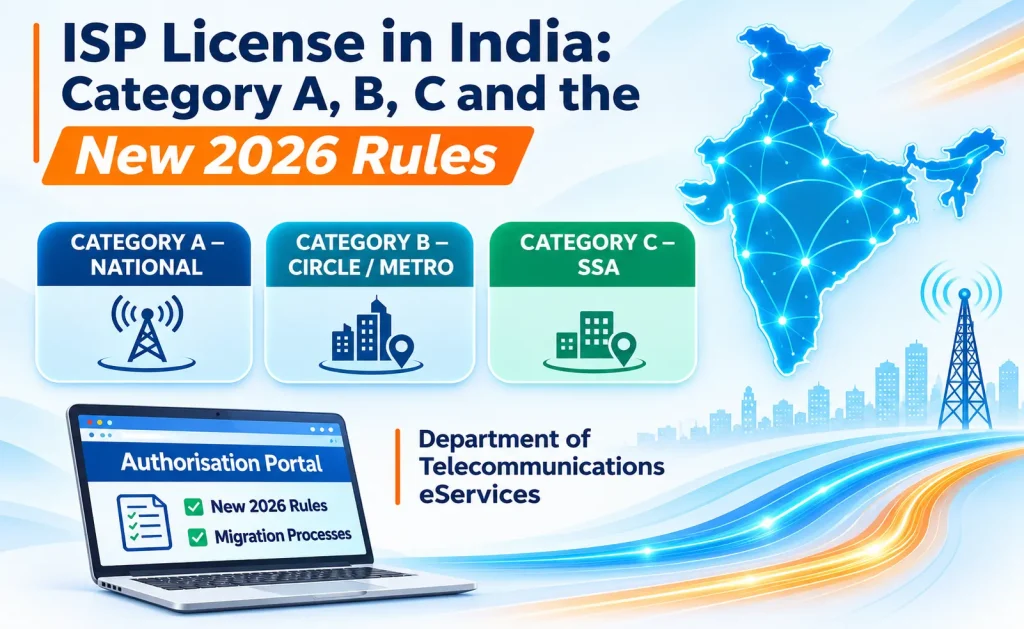
For years, starting an internet business in India meant choosing an ISP licence: Category A, B or C. In June 2026 that changed. The Unified Licence regime for internet services has been replaced by a new Internet Service Authorisation under the Telecommunications Act, 2023. This guide explains what the old Category A, B and C licences were, what has changed, what it means for existing licence holders and new operators, and which costs and compliance steps to plan for.
Important: this article is a plain-language guide, not legal advice. Fees, conditions and forms are set by the Department of Telecommunications (DoT) and can change. Always confirm the current rules and schedules on the official DoT portals before you apply, and take advice from a telecom consultant or lawyer.
What were ISP Category A, B and C?
Under the Unified Licence (UL), an internet service provider chose a category based on the area it wanted to serve:
| Category | Service area | Typical user |
|---|---|---|
| Category A | All of India | National ISPs |
| Category B | One telecom circle or metro (for example, a state or a large metro) | Regional ISPs |
| Category C | One secondary switching area (SSA), roughly a district | Local broadband operators and small ISPs |
Each category came with an application fee, an entry fee, a performance bank guarantee and a financial bank guarantee, plus an annual licence fee of 8% of adjusted gross revenue (AGR). Category A had the highest entry fee and guarantees, and Category C the lowest. For example, DoT’s published entry conditions listed Category C at an entry fee of about ₹20,000, with a performance bank guarantee of about ₹50,000 and a financial bank guarantee of about ₹10,000.
Category C was the most popular route for local operators, because the cost was low and the area matched a single town or district.
What changed in 2026?
On 23 June 2026, the government notified the Telecommunications (Authorisation for Provision of Principal Telecommunication Services) Rules, 2026 under the Telecommunications Act, 2023. The key changes for internet services:
- Licence becomes authorisation. New applicants no longer get a UL with an ISP category. They apply for an Internet Service Authorisation, one of five principal service authorisations.
- Two ways to operate. You can apply as a Network Service Operator (NSO), running your own network, or as a Virtual Network Operator (VNO), using another operator’s network.
- Fewer service areas. According to published summaries of the rules, the internet service authorisation is available for a national area or a telecom circle or metro area. There is no separate district or SSA tier like the old Category C for new applicants.
- Online applications. Applications and migrations are made through DoT’s Authorisation Portal, which opened for applications on 25 June 2026.
- One guarantee instead of two. The separate performance and financial bank guarantees are replaced by a single initial guarantee.
- Authorisations last longer. Authorisations are granted for up to 20 years.
Old licence vs new authorisation
| Old: Unified Licence (ISP) | New: Internet Service Authorisation (2026) | |
|---|---|---|
| What you get | Licence with Category A, B or C | Authorisation as NSO or VNO |
| Service areas | National (A), circle/metro (B), SSA/district (C) | National or circle/metro |
| Guarantees | Performance + financial bank guarantee | One initial guarantee |
| Annual fee | 8% of AGR | 8% of AGR, subject to a minimum fee |
| How to apply | DoT licensing process | DoT Authorisation Portal |
What does it cost now?
The fees are set out in the schedules to the 2026 rules. Published summaries agree on a few points:
- A national internet service authorisation carries an entry fee of about ₹10 lakh.
- A telecom circle or metro authorisation costs much less. Summaries put the entry fee in the range of about ₹50,000 to ₹1 lakh, with lower amounts for some areas such as the North East and Jammu & Kashmir.
- The annual authorisation fee is 8% of AGR, with a minimum fee from the second year.
- There is also an application processing fee and an initial guarantee, which differ for NSOs and VNOs.
Because the published figures differ slightly between sources, check the exact amounts in the official schedule on the DoT portal before you budget.
I already hold a Category A, B or C licence. What now?
- You do not have to stop operating. Existing licence holders are not required to replace their licences immediately.
- You can migrate. Existing licensees may migrate to the corresponding authorisation under section 3(6) of the Telecommunications Act, 2023, through the Authorisation Portal.
- Watch your deadlines. If your licence is close to expiry, the migration rules set time limits for applying. Check them early.
- Category C holders should check carefully. Since the new internet authorisation is offered for national and circle/metro areas, find out how your SSA licence maps to the new framework and what your fees and guarantees will be after migration.
- No overlapping licences. The rules do not allow two licences or authorisations covering the same service and area, so an overlapping licence has to be surrendered when you take a new authorisation.
I want to start an ISP. Which route should I take?
| Route | Good for | Trade-off |
|---|---|---|
| Partner or franchise of a licensed ISP | Starting small in one town or a few colonies | Lowest cost and fastest, but you share revenue and depend on the partner |
| VNO authorisation | Your own brand, using another operator’s network | Lower investment in core network, but you rely on the network owner |
| NSO authorisation (circle/metro) | Growing regional operators with their own network | More control, more investment and compliance |
| NSO authorisation (national) | Large ISPs across many states | Highest fees and obligations |
Many local operators start as a partner of a licensed ISP and apply for their own authorisation once they have a few hundred subscribers. Our guide on how to start an ISP business in India covers the network, costs and first customers in more detail. If you plan to work with franchise partners yourself, see how to manage franchise and LCO partners.
Basic eligibility and documents
- An Indian company registered under the Companies Act
- Paid-up equity and net worth as required by the rules for your authorisation
- Compliance with foreign investment (FDI) rules
- No outstanding dues to DoT
- Company documents, PAN, GST registration and an office address for your network operations
- A statutory auditor’s certificate where required
Compliance after you go live
Getting the authorisation is the start. Every ISP, whatever the route, needs to run these processes from day one:
- Subscriber KYC and CAF records for every connection, stored safely and easy to retrieve.
- Revenue and AGR records for the annual authorisation fee, filed on time.
- GST invoices and returns for every recharge or billing cycle.
- Logs and network records kept as required by the rules, including data storage within India.
- Quality of service and complaint handling in line with TRAI regulations.
How ISPMate helps licensed ISPs and their partners
ISPMate is cloud-based ISP billing software for internet service providers in India. It does not handle licensing or DoT filings, but it keeps the day-to-day records that compliance depends on:
- Digital KYC and CAF documents on every subscriber’s profile
- GST invoices for every recharge and billing cycle
- Revenue, collection and expense reports by period, useful when you prepare AGR and fee filings
- Complaint tickets with status and resolution time
- Reseller and franchise panels with wallets and commission
- Automatic suspension on expiry and reconnection on payment through RADIUS
Frequently asked questions
What are ISP Category A, B and C licences?
They were the three internet service categories under India’s Unified Licence: Category A for all of India, Category B for one telecom circle or metro, and Category C for one secondary switching area, roughly a district. Category C was the cheapest and most common for local operators.
Are ISP Category A, B and C still available in 2026?
Not for new applicants. Since the Principal Telecommunication Services Rules were notified on 23 June 2026, new operators apply for an Internet Service Authorisation as a network service operator or virtual network operator. Existing licence holders can continue and may migrate to the new authorisation.
What is the fee for an ISP authorisation in India?
Published summaries put the entry fee at about ₹10 lakh for a national authorisation and much less for a telecom circle or metro, plus an annual fee of 8% of adjusted gross revenue with a minimum amount. Confirm the exact figures in the official schedule on the DoT portal.
Can a local cable operator start broadband without a licence?
A local operator can work as a partner or franchise of a licensed ISP, which is often the fastest and cheapest way to start. Selling internet service under your own name requires an authorisation from DoT.
Do existing Category C ISPs have to migrate?
Existing licensees are not forced to replace their licences immediately, but they may migrate to the new authorisation, and time limits apply as a licence approaches expiry. Category C holders should check how their SSA area and fees map to the new framework.
Starting or growing an ISP? Get billing, KYC records and renewals right from day one. Book a free ISPMate demo or call +91-9310313545.
Sources: Department of Telecommunications, Principal Telecom Services Rules, 2026; Telecommunications Act, 2023; TRAI recommendations on entry fees and bank guarantees (2023). Last reviewed: November 2026.