
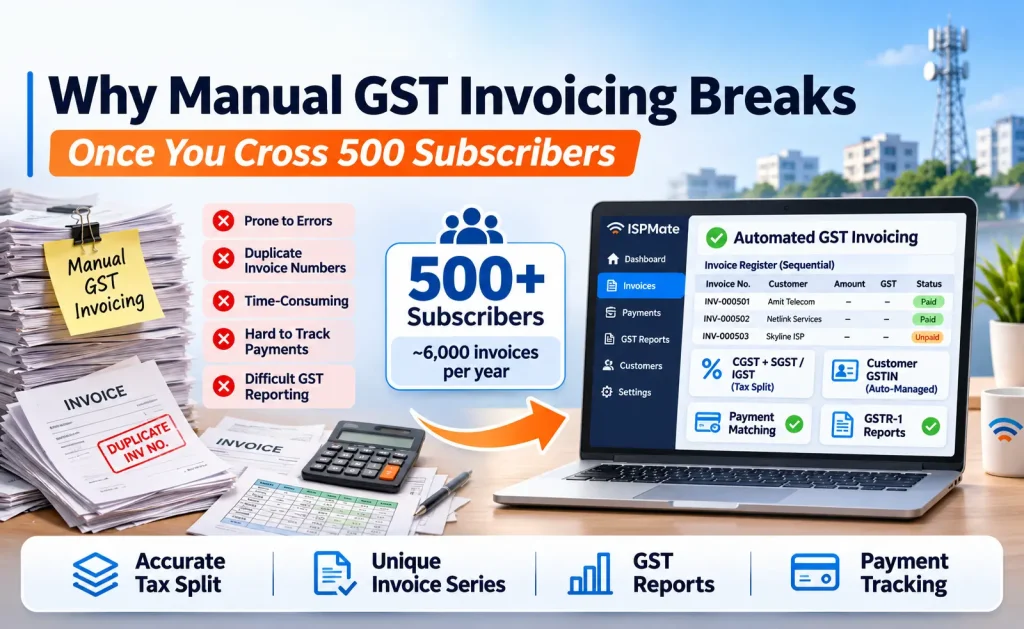
With 100 subscribers, an ISP can make GST invoices by hand. Someone copies last month’s bills in Excel or Word, changes the dates, and sends them on WhatsApp. At 500 subscribers, the same method starts to fail: invoice numbers jump or repeat, the tax split stops adding up, and month-end GST filing turns into a week of corrections. This guide explains where manual GST invoicing breaks for internet service providers in India, what the GST rules expect from every invoice, and how to fix the process before it costs you money.
This article explains common GST practice for broadband billing. It is not tax advice. Confirm your own case with your chartered accountant.
Why 500 subscribers is the breaking point
The problem is volume. At 500 subscribers you raise about 500 invoices a month, or roughly 6,000 a year, before counting refunds, plan changes and installation charges. That is 20 to 25 invoices every working day, each needing a correct number, date, amount, tax split and customer details.
At this size, small error rates turn into real work. If even 2 in 100 invoices have a mistake, that is about 10 wrong invoices every month, each of which must be found and corrected before you file GSTR-1. And mistakes on GST invoices are not just cosmetic: they show up in your returns, your accountant’s reconciliation and your business customers’ input tax credit.
What every ISP GST invoice must get right
Under GST, a tax invoice must carry the details set out in Rule 46 of the CGST Rules. For a broadband ISP, these matter most:
| Field | What it means for an ISP |
|---|---|
| Your name, address and GSTIN | The registered business that provides the connection |
| Invoice number | Consecutive, unique within the financial year, and no longer than 16 characters, using letters, numbers, hyphen (-) or slash (/) |
| Invoice date | Generally within 30 days of the supply of service (Rule 47) |
| Customer name and address | The subscriber, and their GSTIN if they are a registered business |
| SAC code | Internet access services are commonly billed under SAC 998422 |
| Taxable value | The plan price before GST |
| Tax rate and amount | Broadband is taxed at 18%, split as CGST 9% + SGST 9%, or IGST 18% |
| Place of supply | For a fixed broadband line, generally the location where the connection is installed |
| Signature | Physical or digital signature of the supplier or an authorised person |
8 places manual GST invoicing breaks
1. Invoice numbers repeat or skip
When two staff members create bills from copies of the same file, or one person types numbers by hand, the series breaks. You end up with two invoices numbered 0457, or a gap from 0612 to 0620. GST expects a consecutive series that is unique for the financial year. Gaps and duplicates are hard to explain later, and the document count you report in GSTR-1 will not match your records.
2. The tax split does not add up
Most ISPs sell plans at a GST-inclusive price, such as ₹799 a month. The correct split is:
| Item | Amount |
|---|---|
| Taxable value (₹799 ÷ 1.18) | ₹677.12 |
| CGST 9% | ₹60.94 |
| SGST 9% | ₹60.94 |
| Total | ₹799.00 |
In a spreadsheet, it is easy to calculate 18% on top of ₹799 for some subscribers and inside it for others, or to round each line differently. Across hundreds of invoices, the paise add up to a mismatch between your invoices, your collections and your GST return.
3. CGST and SGST get mixed up with IGST
For a fixed broadband connection, the place of supply is generally where the line is installed. If that is in the same state as your GST registration, you charge CGST and SGST; otherwise the treatment changes. ISPs that expand into a neighbouring state, or work with partners across a state border, often copy the same template everywhere and charge the wrong tax type. Ask your CA whether you need a separate GST registration for each state you operate in.
4. Business customers get invoices without a correct GSTIN
Offices, shops and companies that take a broadband connection want to claim input tax credit. For that, your invoice must carry their correct GSTIN and you must report the invoice as a B2B supply in GSTR-1. A single typo in a 15-character GSTIN means the customer cannot see the credit, and you get a call asking for a corrected invoice. When GSTINs are typed by hand every month, this happens often.
5. Plan changes, refunds and discounts are fixed by editing old invoices
A subscriber upgrades mid-cycle, asks for a refund after cancelling, or gets a discount after a long outage. Editing or deleting an invoice that has already been issued is the wrong fix. The usual way is a credit note against the original invoice, or a fresh invoice for the difference. Manual billing rarely tracks credit notes properly, so the numbers in your books and your GST return drift apart.
6. Prepaid recharges are billed late
Many ISPs collect a prepaid recharge first and make the invoice “later”. GST generally expects the invoice for a service within 30 days, and the time of supply for services is usually the earlier of the invoice date and the date you receive payment. When invoices are made in a monthly batch, some fall outside that window, and payments you have collected are not matched to any invoice.
7. GSTR-1 takes days to prepare
From the May 2025 return period, GSTR-1 requires the HSN/SAC summary (Table 12) split into B2B and B2C supplies, and the document summary (Table 13), which lists the range and count of invoices and credit notes you issued. With manual invoices, your accountant has to rebuild all of this from scattered files every month. Every duplicate number, missing invoice or wrong GSTIN found at this stage means another correction.
8. Franchise and LCO partners bill in their own way
If franchise partners collect from subscribers in your name, each one may use their own invoice format, numbering or tax rate. As the licensed ISP, you are the one who has to account for the revenue. Without one central system, you cannot see which invoices were issued in your name, or whether they follow your series. See how to manage franchise and LCO partners.
What good GST invoicing looks like for an ISP
- One invoice series per financial year, generated by the system, never typed by hand
- Invoices created automatically at each recharge or billing date, so none are late or missing
- Tax calculated the same way every time, with one rounding rule and the correct CGST/SGST or IGST
- Customer GSTIN stored once on the subscriber’s profile and printed on every invoice
- Credit notes for refunds and adjustments, linked to the original invoice, instead of edited bills
- Every payment matched to an invoice, whether it came by UPI, card, net banking or a collection agent
- Monthly GST reports your CA can use directly: invoice register, B2B and B2C totals, tax collected and document counts
Do ISPs need e-invoicing?
E-invoicing, where B2B invoices are reported to the Invoice Registration Portal (IRP) to get an IRN, is compulsory for businesses whose aggregate annual turnover has crossed ₹5 crore in any financial year from 2017-18 onwards. It applies to B2B invoices, so it affects ISPs that bill offices and companies. Businesses with turnover of ₹10 crore or more must also report invoices to the IRP within 30 days of the invoice date. If your ISP is close to these limits, check with your CA and confirm that your billing software can produce e-invoices before you cross them.
How to move from manual to automatic GST invoicing
- Clean your subscriber list. Correct names, addresses, plans and the GSTIN of every business customer.
- Fix your plan prices. Decide whether each plan price includes GST, and write down the taxable value and tax for each.
- Agree the invoice series with your CA. For example, one prefix per financial year, kept within 16 characters.
- Start at a clean point. Switch at the start of a month or billing cycle, so one period is not split across two systems.
- Run one cycle side by side. Compare the system’s invoice totals and tax with your old method before you rely on it fully.
- Hand your CA the monthly reports and confirm they are enough for GSTR-1 and GSTR-3B.
If invoicing is only one of your problems, also see 7 signs your ISP has outgrown Excel billing.
How ISPMate handles GST invoicing
ISPMate is cloud-based ISP billing software for internet service providers in India. For GST it gives you:
- A GST invoice created automatically for every prepaid recharge and every postpaid billing cycle
- CGST/SGST tax split calculated on every invoice, with the subscriber’s GSTIN for business customers
- Online payments by UPI, card or net banking recorded against the subscriber automatically
- Cash collected by field agents tracked until the office approves it
- Prepaid wallets and commission for franchise and LCO partners, with billing kept in your system
- Collection, dues and revenue reports you can share with your accountant
Read more about prepaid vs postpaid broadband billing and collecting broadband dues on time.
Frequently asked questions
What is the GST rate on broadband internet service in India?
Broadband internet service is taxed at 18% GST. Within the same state it is charged as 9% CGST and 9% SGST; otherwise as 18% IGST. Installation and activation charges are usually taxed at 18% as well.
What SAC code should an ISP use on broadband invoices?
Internet access services are commonly billed under SAC 998422. Confirm the code for each of your services, such as leased lines or installation, with your chartered accountant.
Can an ISP skip or reuse invoice numbers?
No. GST invoices must have a consecutive serial number, unique for the financial year and no longer than 16 characters. Gaps and duplicates cause mismatches in GSTR-1, so let your billing system generate the numbers.
How should an ISP handle refunds or plan downgrades under GST?
Do not edit or delete an invoice that has already been issued. Issue a credit note linked to the original invoice for the amount being reduced, and report it in your GST return.
Is e-invoicing mandatory for ISPs?
E-invoicing is mandatory for B2B invoices once a business’s aggregate annual turnover crosses ₹5 crore in any financial year from 2017-18 onwards. Smaller ISPs do not need it, but should check their turnover each year with their CA.
Want GST invoices to create themselves on every recharge? Book a free ISPMate demo or call +91-9310313545.
Sources: CGST Rules 46 and 47 (CBIC), GSTN advisory on Tables 12 and 13 of GSTR-1 (May 2025), GSTN e-invoicing advisories, and published GST rate guidance for broadband services. This is general information, not tax advice. Last reviewed: November 2026.